
Restaurant Inventory Management: Know Where Every Bottle and Portion Goes
Restaurant inventory management is the practice of tracking stock purchases, sales deductions, and adjustments so that what you bought, what you sold, and what remains always reconcile.
You bought 48 bottles. The system sold 39. Where are the other 9? Most venue owners cannot answer that question, and the gap between what you bought and what you sold is the most expensive number in your business. MenuByte tracks stock against actual sales so the gap has nowhere to hide.
Request a Free Demo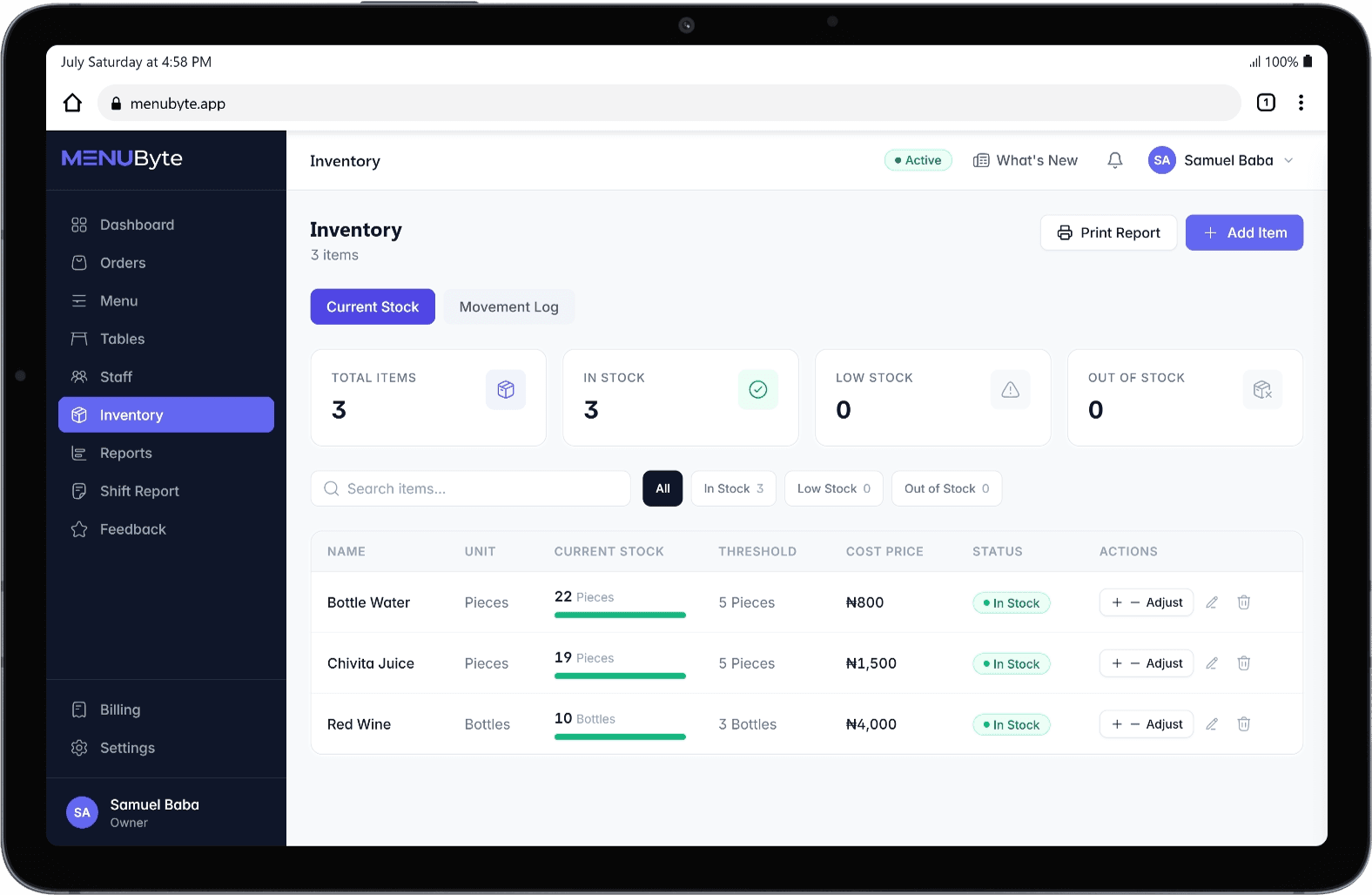
Loss is a drip, not a heist
Inventory loss in hospitality is rarely one big theft. It is a steady drip: the drink served but never rung up, the spilled bottle, the generous pour, the store items that walk out in a bag, the supplier delivery that was short but signed for anyway.
Each incident is small enough to be deniable. Together they commonly reach 5 to 10 percent of stock value in venues with no tracking, and the owner only feels it as being busy while the money is not adding up.
Why nobody catches it
Paper stock counts and sales records live in different books, kept by different people, and reconciling them takes hours nobody has. So reconciliation happens rarely or never, and staff learn that nobody is checking.
It is not that any venue has worse staff. Untracked stock creates the opportunity, and opportunity plus time equals loss everywhere in the world.
What a 7 percent drip costs
A lounge holding N2,000,000 of monthly stock and losing 7 percent to shrinkage would be losing N140,000 a month, N1,680,000 a year, silently.
That loss compounds: missing stock also means surprise stockouts on busy nights, emergency purchases at bad prices, and menus promising items the bar cannot make.
How MenuByte makes the gap visible
MenuByte links inventory to sales. When an item sells, stock deducts automatically. Every manual adjustment for breakage, waste, or restock requires a reason and carries the name of the staff member who made it.
Low stock alerts fire before you run out. The owner sees purchased versus sold versus adjusted in one report, so a 9 bottle gap is a same-day question, not a year-end mystery.
From delivery to report
- 1
Set up items with stock quantities, or we do it during onboarding
- 2
Sales deduct stock automatically in real time
- 3
Staff record adjustments with reasons: breakage, waste, restock
- 4
Low stock alerts appear on the dashboard
- 5
Owner reviews the stock movement report: every deduction, every adjustment, every name
Auto-deduction on sale
Sales and stock can never quietly disagree.
Named adjustments
No anonymous corrections. Every change carries a name and a reason.
Low stock alerts
Reorder before the Friday rush, not during it.
Owner-only reports
The full movement picture, from anywhere.
- Shrinkage becomes visible, and visible shrinkage shrinks
- Staff behavior changes the week tracking starts
- No more stockouts on peak nights
- Purchasing based on real consumption, not guesswork
Frequently asked questions
Related solutions
The Restaurant POS System Built for Nigerian Venues
A restaurant POS system is software that records orders, sends them to the kitchen, tracks payments, and gives the owner a complete record of every sale.
QR Code Ordering: Let Customers Order From Their Table
QR code ordering lets restaurant customers scan a code at their table, view the live menu on their phone, and send orders directly to the kitchen without a waiter taking the order.
Restaurant Staff Management: Every Action Carries a Name
Restaurant staff management software gives each staff member their own account with defined permissions, so every order, payment, void, and stock adjustment is recorded against the person who did it.
Bring your last stock count. We will show you what the gap looks like when it is tracked.